
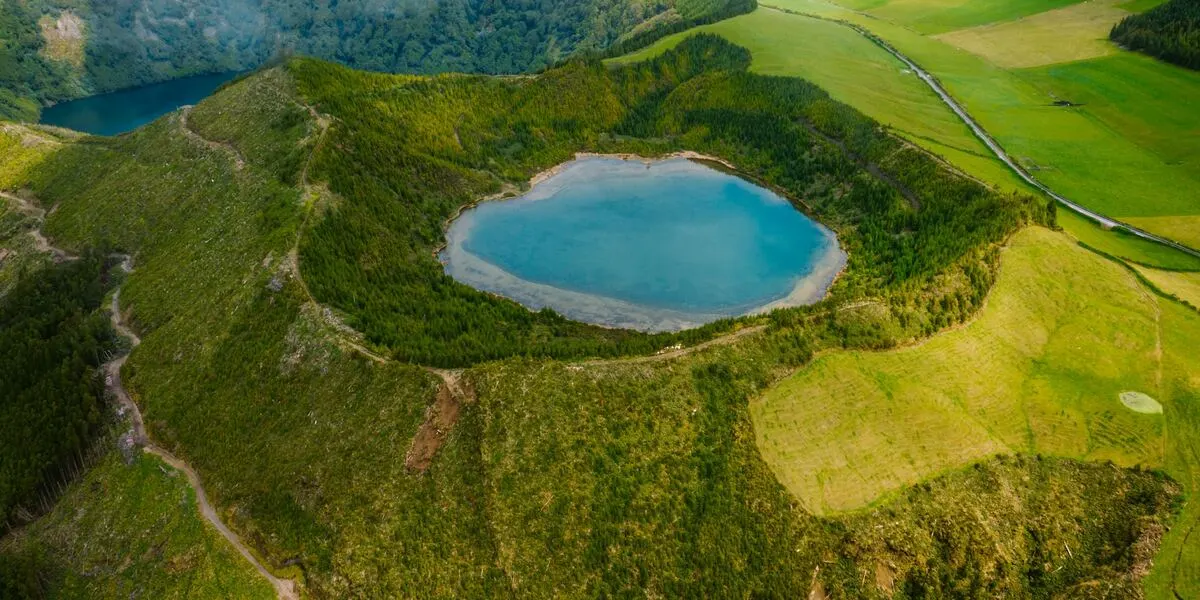
Nine green islands scattered across the mid-Atlantic invite a particular fantasy: a week spent skimming between them, a different harbour every evening. The geography does not cooperate. São Miguel, the biggest island and the one with the crater lakes, the hot springs and the only nonstop flight from Britain, has no passenger ferry service at all. Its nearest neighbours in the central group are around forty-five minutes away by propeller plane. The question in the title is really a choice between two different holidays, and pretending otherwise is how a good week gets spent in departure lounges.
Here is the split. São Miguel is a base: one set of keys, one hire car, and more varied days out than a week can use. The islands of Faial, Pico and São Jorge (the “Triangle”, as the Portuguese tourism authorities officially call them) are the genuine island hop: year-round ferries, crossings from about thirty minutes, and three strong characters close enough to compare over breakfast. What does not work well is treating the whole archipelago as one route.
For a first Azores trip of a week, base on São Miguel and spend nothing on internal transport but petrol. It has the two landscapes everyone comes for, the largest whale-watching fleet, and the only UK nonstop. Island-hop when you can commit nine or more nights, or make the Triangle its own separate trip, flying via Lisbon into Horta and letting the ferries do the work. Our preferred window for either version is the first half of September: the sea is at its warmest, the August crowds are thinning and the autumn rain has not properly arrived.
Warm, never hot, and always changeable
The Azores are a maritime climate with no fine print hidden: the official record high at Ponta Delgada’s observatory, in a series running back decades, is 30.1°C. Not one day over 30°C appears in any month of the 1991–2020 normals. What the islands offer between August and October is steady, usable warmth with a sea that outperforms the air.
| Ponta Delgada normal | Aug | Sep | Oct |
|---|---|---|---|
| Mean daily maximum | 26.0°C | 25.0°C | 22.6°C |
| Mean night minimum | 19.9°C | 19.1°C | 17.1°C |
| Rainfall | 45.8mm | 78.2mm | 118.0mm |
| Rain days (≥1mm) | 6.5 | 9.4 | 13.7 |
| Sea temperature | ~23°C | ~23°C | ~21°C |
Read the rainfall row from left to right: it roughly doubles every month as autumn arrives. August is the driest and warmest of the three, but it is also the peak of the Portuguese holiday season, when the regional statistics service records the year’s highest visitor numbers. September splits the difference, with the sea holding at around 23°C, warmer than it was in June. October is the gamble, still mild but wet on more days than not. The islands’ own tourism board is admirably blunt about the fine print: clouds and rain are a possibility at any time of year. Locals compress the same fact into a saying about four seasons in one day. Neither is a reason to stay home; both are a reason never to build a day around a single viewpoint staying clear.
One more number worth respecting: the record daily rainfall at Ponta Delgada fell in September: 173.6mm in twenty-four hours. The shoulder season’s occasional soaking is biblical rather than British. The response is the same flexible planning this site recommends everywhere: keep the crater-rim day movable, and have a hot-spring day ready for the rain.
Choose São Miguel for a week that never repeats itself
São Miguel’s advantage is concentration. The twin lakes of Sete Cidades fill one giant crater in the west; Furnas in the east steams with fumaroles and more than twenty thermal springs, where the local stew is cooked in the volcanic ground and the century-old Terra Nostra garden has a swimming pool the colour of stewed tea and the temperature of a bath. Between them: tea plantations, black-sand beaches, and a working capital in Ponta Delgada that does not empty when the day trippers leave.
São Miguel is the stronger fit when
- this is the first Azores trip and the week is seven nights or fewer;
- whale watching matters, because the island has the largest fleet and the most departures;
- you want one accommodation, one hire car and no weather-dependent connections;
- the party includes anyone for whom a thirty-minute propeller flight is a cost, not a treat.
The honest downside is that São Miguel knows it is the gateway. Vista do Rei at Sete Cidades and the Furnas pools take coach traffic in August that the rest of the archipelago never sees. The response is timing, not avoidance: the famous viewpoints before ten or after four, and September rather than August if the school calendar allows.
The real island hop is the Triangle
Faial, Pico and São Jorge sit close enough together that the ferry between Horta and Madalena takes about half an hour and costs a single-figure fare. Crossings run year-round, several a day even in winter and more in summer, and the longer legs to São Jorge stay under two and a quarter hours. This is island-hopping as the fantasy imagines it: you genuinely can have coffee on one island and lunch on another, with Pico’s volcano, the highest mountain in Portugal, rearranging the view from every deck.
The three islands earn the comparison. Faial has Horta, the mid-Atlantic sailing port whose marina walls are painted with decades of yacht crews’ murals. Pico has the mountain, the UNESCO-listed vineyards growing in black lava corrals, and a whaling history turned into museums and lookout towers. São Jorge is a knife-edge ridge of fajãs (coastal shelves under the cliffs) and the Azores’ best cheese. A nine- or ten-night trip that flies into the Triangle via Lisbon, hops by ferry, then flies to São Miguel for a final few days is the strongest complete Azores itinerary we can construct. It is also, plainly, a bigger undertaking than most first visits want.
| The move | How | Time | Typical cost |
|---|---|---|---|
| São Miguel to anywhere | SATA inter-island flight, hubbed on Ponta Delgada | 35–70 min flying, half a day door to door | Typically €60–120 one way |
| Horta (Faial) to Madalena (Pico) | Atlânticoline ferry, year-round | ~30 min | ~€8 |
| Within the Triangle to São Jorge | Ferry, year-round; more sailings in summer | 30 min–2¼ h | Under €20 |
The table is the argument. A “hop” from São Miguel is not a hop; it is a regional flight with airport time on both ends, a ten-kilo cabin-class baggage allowance that surprises people who checked twenty-three kilos from Heathrow, and a schedule that weather can rearrange at short notice. Inside the Triangle, the same idea costs less than a round of drinks and takes half an hour. Spread a seven-night week across both groups and you will spend more time in transit than at either end of it.
Getting there is the constraint nobody prices in
The UK connection got thinner this year. Ryanair ended its Azores flying entirely in March 2026 after a dispute over airport charges, which removed the budget route network. That leaves British Airways from Heathrow to Ponta Delgada as the only nonstop: around four hours ten minutes, currently twice a week, seasonal until late October 2026. The twice-weekly pattern quietly dictates trip length: seven or fourteen nights, or a connection. Everything else goes via Lisbon or Porto, where TAP and Azores Airlines run year-round services, including direct Lisbon flights to Horta and Pico on thin frequencies for those building the Triangle-first itinerary.
Two claims that circulate in blog guides deserve correcting. The Azores Airlines free stopover applies to transatlantic passengers between North America and Europe, not to travellers starting in the UK. And the free inter-island connection scheme sometimes described is a public-service arrangement for Azorean residents and students, not visitors. Budget the hops at full fare or route around them with the ferries.
The whale question answers itself by season
The Azores are one of the world’s established whale-watching grounds. Operators off São Miguel have logged twenty cetacean species across more than four thousand recorded trips, and their data feeds international biodiversity science. But the calendar matters more than the brochure. Sperm whales and several dolphin species are resident year-round. The giants, the blue and fin whales, pass through in spring, with April and May the strong months. Book an August-to-October trip and the realistic expectation is sperm whales, big dolphin pods and possibly a sei whale, not a blue.
That has a useful consequence for this guide’s question: in this window there is no whale-watching reason to hop. The fleet is largest on São Miguel, trips also run from Pico’s old whaling town of Lajes, and no data we can find shows either base out-sighting the other. Treat the operators’ headline success rates (98 per cent is commonly quoted) as meaning a cetacean of some kind, usually dolphins, with a repeat trip offered rather than a refund if nothing surfaces. It is an honest system, but it is not a guarantee of a whale.
What to settle before paying
- Pick the shape first. Seven nights or fewer: São Miguel. Nine or more, or a second visit: the Triangle, or Triangle plus São Miguel with a single internal flight.
- Check the BA pattern against your dates. Twice a week means the flight chooses your trip length; via-Lisbon routings free the calendar at the cost of a connection.
- Hire the car with the accommodation. São Miguel’s buses are commuter services, and the sights are dispersed; nearly every visitor drives.
- Book whale trips for early in the week, so a weather cancellation can roll forward instead of expiring.
- Pack for four seasons. The local saying is a packing list: waterproof shell, warm layer and swimwear share the same daypack here.
- Leave the buffer. If the itinerary includes any inter-island leg, spend the last night on the island you fly home from.
Arrival admin is standard Schengen: the Entry/Exit System takes fingerprints and a photo on first entry, passports need issue within ten years and three months’ validity beyond departure, and the 90-in-180-day visitor limit applies. Nothing about the Azores differs from mainland Portugal on this front.
Inter-island travel in the Azores: quick answers
Is there a ferry from São Miguel to the other islands?
No. The Atlânticoline passenger ferries don’t call at São Miguel, so leaving the island means taking an Azores Airlines (SATA) flight. That’s the main reason we suggest staying put on São Miguel for a first week.
Which Azores islands can you hop between by ferry?
Faial, Pico and São Jorge. Horta to Madalena takes about half an hour and costs around €8. The longer runs out to São Jorge take up to about two and a quarter hours and cost under €20. The boats run all year, with more sailings in summer.
How long do inter-island flights take, and what do they cost?
Between 35 and 70 minutes in the air, but allow half a day once you add the airport at each end. Expect to pay roughly €60 to €120 one way. The cabin-class bag allowance is 10kg, which catches out a lot of people who flew in from the UK with a 23kg case.
Can you see São Miguel and the ferry islands in one week?
You can, but you’ll spend a big chunk of the week getting between them. It starts to make sense at nine or ten nights: fly into Horta via Lisbon, use the ferries, then fly to São Miguel for the last few days.
Do visitors get free inter-island flights?
No. The free inter-island scheme you may read about is for Azorean residents and students. The Azores Airlines stopover deal is for people flying between North America and Europe, not for trips starting in the UK. Budget for full fares.
Sources and what they support
- IPMA, Ponta Delgada climate normals 1991–2020: all temperature and rainfall figures, the 30.1°C record high and the September daily-rainfall record.
- Seatemperature.org, Ponta Delgada: sea temperatures (satellite-derived secondary source).
- Visit Azores, weather: “clouds and rain are a possibility any time of the year”; Visit Portugal, São Miguel: Sete Cidades and Furnas descriptions; Visit Portugal, the Triangle islands: the official grouping of Faial, Pico and São Jorge.
- FlightConnections, Ponta Delgada arrivals (checked August 2026): British Airways as the only UK nonstop, twice weekly; Simple Flying: Ryanair’s complete Azores exit from 29 March 2026.
- Azores Airlines, summer 2026 operation: inter-island network (about 572 weekly flights), Lisbon routes including Horta and Pico; Azores Airlines stopover terms: the programme’s North America–Europe scope.
- Atlânticoline timetables: the ferry network’s ports and lines, which include no São Miguel service; crossing times and fares corroborated by current Azores ferry guides (Horta–Madalena ~30 minutes, ~€8, checked August 2026).
- Futurismo, whale-watching seasonality: resident species, the spring baleen migration and summer arrivals; OBIS dataset: 20 species over 4,219 recorded trips off São Miguel.
- SATA inter-island flying guide (May 2026): hub routing, the 10kg inter-island baggage allowance and rescheduling risk.
- FCDO Portugal entry requirements: Schengen passport rules, the Entry/Exit System and the identical treatment of the Azores.
- 23 September 2026
- Title and summary reworded to match how people search for Azores inter-island travel, and a quick-answers section added. It uses the facts checked on 3 August; nothing new was checked this time.
- 3 August 2026
- Climate normals (IPMA 1991–2020), 2026 UK and inter-island flight schedules including Ryanair’s March exit, ferry network scope, whale seasonality and entry rules checked. Ferry and flight fares are indicative ranges, not live quotes.