
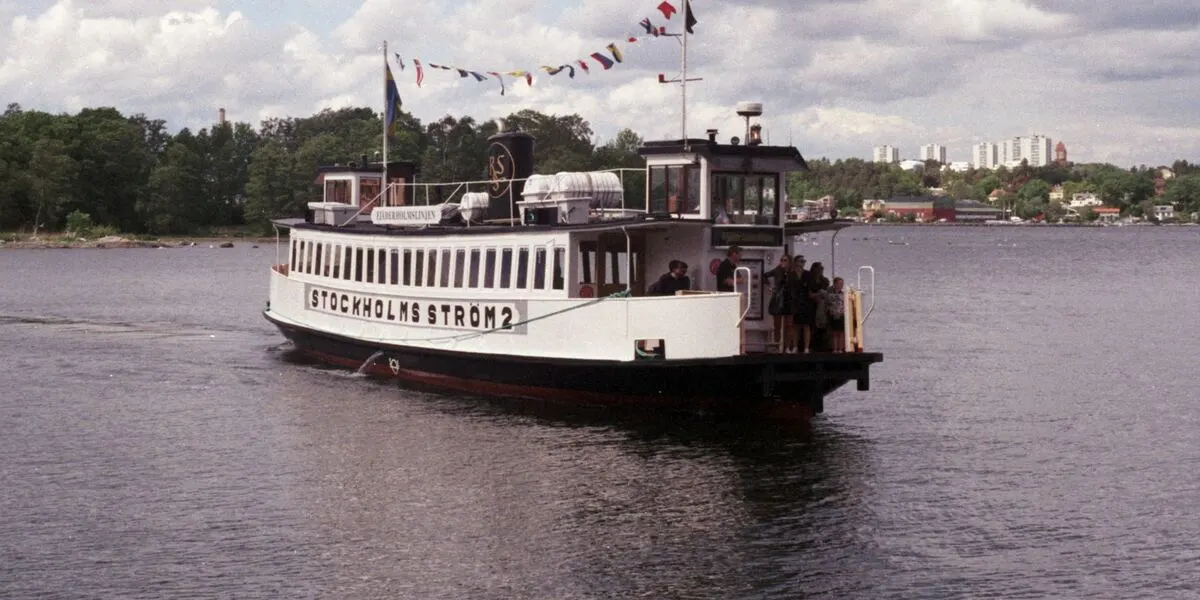
Most capitals keep their islands for the postcards. Stockholm runs buses to the water and boats beyond it: a publicly owned, tax-subsidised ferry network that serves 299 jetties across the archipelago in summer and keeps sailing all winter. There is no cruise to book and no tour to join. You walk to the quay by the Grand Hôtel, board a white boat, touch in like it was a bus, and forty minutes later the city has been replaced by pine, granite and water. A single fare costs between about £5 and £15 depending on distance.
That is the good news. The discipline is the calendar. Waxholmsbolaget, the operator, changes its timetable four times a year, and the summer network, the full version with the direct long runs and the most departures, exists only between 19 June and 16 August in 2026. On Monday 17 August the autumn timetable takes over, which happens to be the same day Stockholm’s schools go back. The archipelago does not fade out of season. It switches, on a published date.
Base in Stockholm for a first trip and use the boats as day-trip transport: Fjäderholmarna for an evening, Vaxholm for half a day, Grinda or Utö for a full one. Sleep out on an island only with a bed booked first and the last boat checked twice. The 2026 summer timetable finished on 16 August, so for the rest of this year you’re on the smaller autumn and winter service. There’s an upside: since 14 September, an ordinary SL 30-day travelcard covers the whole boat network, and the half-price 30-day boat pass is on sale until 1 December. Vaxholm, Utö and every other island in this guide keep a boat service all winter, but a lot of island cafés and inns close or go weekends-only, so check before you set off. If you want the full summer network, plan for next June.
Public transport, not a cruise
Waxholmsbolaget has been carrying islanders and their shopping since the age of steam, and its rules are the rules of a bus company. There are no seat reservations: you turn up at the jetty and board, and the operator itself says only that on fine-weather weekends it is wise to arrive early. Single fares run in six distance bands from SEK 61 to SEK 186, roughly £4.75 to £14.50, with children under seven free and discounts for teens and over-65s. A return is simply two singles. The boats are cashless, which in Sweden is not a quirk but the norm: the Riksbank’s latest payments survey found only five per cent of Swedes paid cash for their last in-store purchase, and the Foreign Office bluntly warns that many Swedish shops and cafés no longer accept it at all.
The passes are where it gets interesting. The classic island-hopping ticket survives as a 5-day pass at SEK 595, about £46, sold on board and loaded onto an SL smartcard. But a temporary government subsidy has cut the 30-day boat pass to half price, SEK 530, until 1 December 2026. The operator points out the absurdity itself: right now the month-long pass costs less than the five-day one. If your trip includes three or more boat days, buy the 30-day ticket and stop thinking about fares.
Two more rules reward the well-timed. Any SL ticket, even a single, already covers the boats in the inner area between Strömkajen and Vaxholm, a zone of 44 jetties, all year round. And from 14 September to the end of April, SL travelcards of 30 days or longer become valid across the entire archipelago network. A visitor with an ordinary Stockholm month card in late September can ride to the outer islands for nothing extra. One caution the operator states plainly: its tickets are not valid on other companies' boats, so the Strömma and Cinderella tourist services are a separate purse.
The season ends on a date, not a feeling
Here is what Sunday 16 August actually removes. The direct summer run from central Stockholm to Sandhamn, line 15, three hours through the heart of the archipelago with the 08.30 boat out and the 17.20 boat back, does not exist in the autumn timetable at all; from 17 August, Sandhamn is reached year-round but by bus to Stavsnäs and a shorter crossing. Utö drops from eight departures a day to about six, and several smaller jetties become request stops that want an hour’s notice. Whole summer-only links, like the cross-archipelago north-south line, stop until next June.
The islands' own businesses follow the same rhythm, some of them startlingly early. Utö's hostel closed for the season on 6 August this year and its sailors' bar three days later. Fjäderholmarna’s season runs to 13 September. Sandhamn’s historic inn keeps its restaurant on daily service only until mid-September, then retreats to weekends. Grinda’s art nouveau inn holds out from April to early November. Against that, a real year-round layer remains: Vaxholm is a functioning town in all twelve months, Utö Värdshus keeps its 80 rooms open through winter, and every island in this guide keeps a scheduled boat service of some kind. The archipelago closes its summer shop; it does not close.
| Stockholm normal | August | September |
|---|---|---|
| Mean daily maximum | 22.0°C | 16.6°C |
| Rainfall | 66mm | 53mm |
| Rain days (≥1mm) | 9.0 | 7.9 |
| Sea temperature (outer buoy) | ~17–18°C | ~15–16°C |
| Daylight, 20th of month | 15h 13m | 12h 31m |
Read September fairly: cooler air, but a drier month than August, and a sea that cools far more slowly than the land. The Baltic around the outer islands holds the mid-teens well into September, per the Swedish met office’s own buoy at Huvudskär, and sheltered bays run warmer. Swedes even have an official name for the last act: SMHI, the met office, defines brittsommar as the recurring spell of warm, sunny days around 4 to 10 October. It is a lottery ticket, not a plan, but it is a state-certified lottery ticket.
The day-trip islands, in order of commitment
| Island | From | Time | The honest version |
|---|---|---|---|
| Fjäderholmarna | Slussen or Strandvägen | 20–30 min | An evening’s taste: craft studios and a brewery, season to 13 September |
| Vaxholm | Strömkajen, or bus 670 | ~1 h by boat | The archipelago’s small capital, a real town in all seasons |
| Grinda | Strömkajen via Vaxholm | 1–1½ h | Car-free nature-reserve island; inn open April to early November |
| Utö | Bus to Årsta brygga, then boat | ~40–55 min crossing | Year-round day trip: old iron mines, bike hire, proper inn |
Fjäderholmarna is the exception that proves the public-transport rule: it sits so close to the city that it is served by its own short-hop boats rather than the archipelago network, and the official visitor guidance notes the Slussen departure is covered by an SL card. Treat it as the after-work island. Vaxholm is the opposite: a fortress, streets of wooden houses and around 12,000 year-round residents, whatever older guidebooks say about it being a hamlet. Grinda is the postcard, one hour and a bit out, with swimming rocks and one inn. Utö adds industrial history: mine shafts worked since the Middle Ages, and lanes flat enough that hiring a bike is the correct decision, not the sporty one.
When to sleep out there
The overnight islands, Sandhamn, Utö and Finnhamn on the official grouping, are what the archipelago fantasy is really made of: an evening quay after the day boats leave, and water in every direction at breakfast. The constraint is arithmetic. Grinda has one inn. Utö Värdshus has 80 rooms. Finnhamn has a single hostel and some cabins. The official visitor site’s advice is two sentences that should be read as law: booking ahead is always recommended, and check ferry schedules carefully when planning multi-day stays.
The second sentence matters because the last boat is early by British standards. Sandhamn’s own directions page says the final summer boat back to Stockholm leaves around 20.00; Waxholmsbolaget’s direct summer service leaves Sandhamn at 17.20. Nights out here are committed nights, not late decisions. And this site’s standing rule applies on water as on land: never put an island departure on the same morning as the flight home. Spend the last night in Stockholm.
Getting there, and what Sweden costs in small ways
Six UK airports have nonstop flights to Stockholm Arlanda in about two and a half hours: Heathrow with BA and SAS running roughly seven a day between them, Gatwick with Norwegian, Stansted and Birmingham with Ryanair, and Manchester and Edinburgh with a Norwegian and SAS mix. One piece of received wisdom is dead: the old budget-airline airport at Skavsta, 100km from town, currently has no UK flights at all since Ryanair moved to Arlanda. Every UK route now lands at the main airport, which simplifies everything.
From Arlanda, the Arlanda Express train does the 18-minute run to the centre for SEK 340, about £27, which stings until you know the alternative trap: the cheaper SL commuter train is fine at about SEK 200 all-in, but only because a SEK 157 station passage fee is quietly added at the airport gates on top of the SL fare. The airport coach undercuts both at around SEK 99 online if the timetable suits. Entry admin is the standard Schengen set: 90 days in any 180, the usual passport rules, and biometric registration under the Entry/Exit System on first arrival.
What to settle before paying
- Pick your window first. Full summer network: mid-June to mid-August (it ran 19 June to 16 August in 2026). Quiet and still warm in the water: first half of September. Cheapest boats for a longer stay: after 14 September on an SL travelcard.
- Base in the city for a first trip. A Stockholm hotel plus two or three island days beats dragging bags between jetties, and September rates run below July’s.
- Book island beds before boats. The rooms are the scarce resource; the boats are scheduled public transport.
- Plan around the last boat, not the first. It leaves earlier than a British dinner. Around 20.00 from Sandhamn in high summer, earlier on the operator’s direct line.
- Buy the right ticket. One or two crossings: singles. Three or more boat days before December: the half-price 30-day pass at SEK 530. Staying after 14 September: an SL 30-day card covers everything.
- Bring cards, not kronor. The boats and most of the country will not want your cash.
- Pack for a Baltic 22 degrees. The August average high reads warm; the wind on a foredeck does not.
Stockholm archipelago ferries: quick answers
Where do the archipelago ferries leave from?
Most Waxholmsbolaget boats leave from Strömkajen, the quay outside the Grand Hôtel in the city centre. Boats to Fjäderholmarna, the closest island, go from Slussen or Strandvägen. For Utö you take a bus to Årsta brygga and get the boat from there.
How much does the ferry cost?
A single costs SEK 61 to SEK 186 depending on distance, which is about £4.75 to £14.50. Children under seven go free. A return is just two singles. The boats don’t take cash, so bring a card.
Can I use my SL ticket on the boats?
Any SL ticket covers the boats between Strömkajen and Vaxholm all year. From 14 September to the end of April, SL travelcards of 30 days or more cover the whole archipelago network. SL tickets don’t work on the Strömma or Cinderella sightseeing boats, which are run by other companies.
Do I need to book the ferry?
No. You can’t reserve a seat. Just turn up and get on, and get there early on sunny weekends. It’s the island hotels and inns you need to book ahead, not the boats.
What’s the easiest island for a day trip?
Vaxholm. It’s about an hour by boat or you can get the 670 bus, and it’s a proper town that stays open all year. If you only have an evening, Fjäderholmarna is 20 to 30 minutes from the city.
Sources and what they support
- Waxholmsbolaget in English and about the operator: the public, year-round, tax-subsidised network, 299 summer jetties, and the no-reservations rule.
- Waxholmsbolaget single fares and period tickets (Swedish page): the SEK 61–186 fare bands, the 5-day pass at SEK 595, and the 30-day pass at half price (SEK 530) until 1 December 2026 under the state subsidy.
- Waxholmsbolaget tickets overview: SL tickets valid year-round across 44 inner-area jetties, and SL 30-day-plus travelcards valid network-wide 14 September to 29 April.
- Waxholmsbolaget line timetables: the 2026 summer period 19 June to 16 August, the autumn period from 17 August, the summer-only direct Sandhamn line 15 and Utö frequencies.
- City of Stockholm school calendar: autumn term begins 17 August 2026.
- Visit Stockholm on the archipelago, where to stay and getting there: the day-trip and overnight island groupings and the book-ahead advice.
- Archipelago Foundation: Grinda, Utö and Finnhamn, with Fjäderholmarna’s season dates, Sandhamn’s travel page and Utö Värdshus opening times: island facts, seasons and last boats.
- SMHI climate normals 1991–2020 and the Huvudskär buoy archive: the weather table (sea figures are our aggregation of SMHI buoy observations); SMHI on brittsommar: the defined early-October warm spell.
- FlightConnections, Arlanda (checked August 2026): UK routes and frequencies, and Skavsta’s current lack of UK service; Arlanda Express fares and Swedavia on airport trains: the SEK 340 fare and the SEK 157 station passage fee.
- FCDO Sweden entry requirements: Schengen rules, the Entry/Exit System and the warning that many Swedish businesses no longer take cash; Riksbank payments report: five per cent of purchases in cash.
- 23 September 2026
- The summer 2026 timetable has ended, so the verdict and trip signal now cover the autumn and winter service. Title and summary reworded, and a quick-answers section added. All of it uses the facts checked on 5 August; nothing new was checked this time.
- 5 August 2026
- Fares, the half-price 30-day ticket, 2026 timetable dates, island seasons, SMHI normals, UK flight schedules and entry rules checked against the sources above. Currency converted at roughly SEK 12.8 to the pound.