
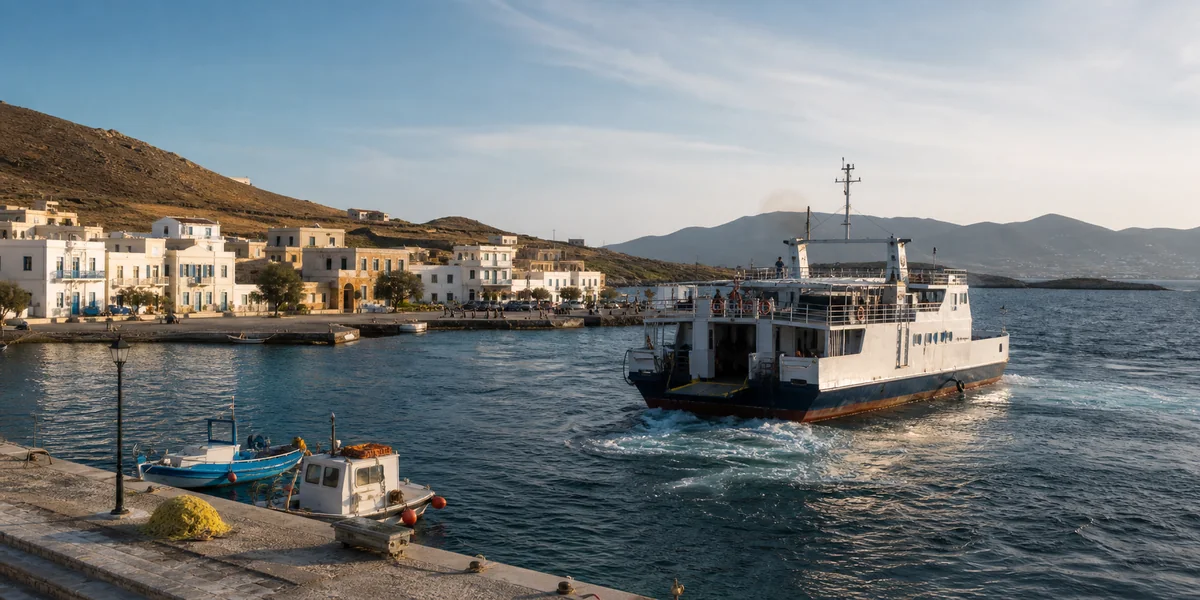
June and September both suit a Cyclades trip, but for different reasons. June gives you more daylight for walks and village visits. September suits travellers who want to spend more of the day swimming.
Keep the route manageable. Every change of island involves packing, checking out and getting to the port as well as the crossing. For a first trip, two islands are plenty.
Choose the middle of June if walking, villages and long usable days matter as much as swimming. Choose the first half of September if the sea is the centre of the holiday and you can live with shorter evenings. Our narrow overall preference is 8–22 June: the seasonal network is fully awake, the solstice gives you nearly the longest possible days and the month leaves more room for an active trip. For a beach-led break, reverse the answer and take 5–18 September.
The two months are closer than the clichés
Naxos is a useful weather station for a central-Cyclades trip. Hellenic National Meteorological Service normals put its mean June temperature at 23.5°C and September at 23°C. The mean daily maximum differs by less than one degree. September nights are fractionally warmer in the same series. These are monthly averages, not a promise for the fortnight you book.
| Naxos climate normal | June | September | What it means |
|---|---|---|---|
| Mean temperature | 23.5°C | 23°C | Air temperature alone does not settle the argument |
| Mean daily maximum | 25.9°C | 25.1°C | Both can deliver properly warm afternoons |
| Mean daily minimum | 19.6°C | 20.1°C | September evenings are not automatically cooler |
| Mean rainfall | 2.4mm | 7.7mm | Both are usually dry; September carries slightly more change |
| Mean wind speed | 10.3kt | 13.9kt | Do not market September to yourself as wind-free |
The last row is the correction most travel copy needs. The Aegean’s northerly Etesian winds are a summer pattern that does not switch off in August: in this series, September’s mean is no lower than June’s, even though the wind’s peak months are July and August. Averages flatten individual spells: either trip can include several quiet days or a hard blow. Weather can alter a crossing, a small-boat excursion or simply which side of an island has the comfortable beach.
June’s clearer advantage is daylight. Around the summer solstice, Naxos has roughly fourteen hours and three quarters between sunrise and sunset. By the second half of September, the day is moving towards twelve hours. That missing light is not academic when a bus back from a mountain village, a swim and dinner all have to fit into the same day.
Choose June for a trip that keeps moving
In June, the islands feel open for summer rather than tired by it. That does not mean empty, cheap or undiscovered. It means the practical pieces (seasonal ferries, beach businesses, buses and boat trips) are operating while the calendar still gives you long margins around them.
June is the stronger fit when
- you want to walk old paths or explore inland villages before the hardest midsummer heat;
- you prefer a long evening after a full day rather than making sunset the end of it;
- your route includes a smaller island whose seasonal connections thin later in September;
- cooler water is an acceptable exchange for a more active week.
The first few days of June can still feel like the beginning of the beach season, especially to someone who wants bathwater rather than a refreshing swim. That is why the recommendation starts around the second week. Late June brings warmer water but also moves closer to peak demand and stronger summer heat. Compare late June separately if avoiding peak demand matters.
Choose September for swimming
By September, the Aegean has stored a summer’s heat. Sea-surface temperature varies by coast, depth, wind and recent weather, so a single number would be false precision. The useful direction is reliable: for most swimmers, the first half of September is a kinder bet than the first half of June.
September also changes the rhythm. Families tied to the British school calendar have largely gone home; sunset arrives earlier; tables turn over less frantically away from the famous lanes. None of that makes Paros or Naxos deserted. Early September remains a real summer period, and the most wanted rooms and restaurants do not suddenly become walk-in propositions on 1 September.
September is the stronger fit when
- swimming and beach time are the main event;
- you would trade two hours of daylight for warmer water and later starts;
- you can travel in the first half of the month, while the broadest seasonal network is still running;
- you are happy to keep one day flexible if wind changes the best beach or boat plan.
Late September is a different recommendation. It can be lovely, but the trip needs a larger island, fewer moving parts and less dependence on seasonal excursions. If your dates begin after about 20 September, make Naxos the anchor and treat a second island as optional rather than compulsory.
For a first trip, make it Naxos and Paros
Naxos and Paros are close enough to combine without turning the holiday into logistics, and different enough to justify the move. Naxos gives the trip scale: a working main town, long western beaches, mountain villages and enough inland road to reward four proper nights. Paros is the neater second act, with Parikia, Naousa, Lefkes, several beach areas and the easy possibility of crossing to Antiparos without moving hotels again.
Naxos and Paros are a useful first pairing because they have straightforward mainland connections and enough to do without adding another ferry. Check the services for your dates before booking.
| Trip length | Route | Our suggestion |
|---|---|---|
| 7 nights | One island | Choose Naxos and make Paros or Koufonisia a day trip only if conditions suit |
| 9 nights | Athens 1 · Naxos 4 · Paros 3 · Athens 1 | The minimum island hop we would book from the UK |
| 10 nights | Athens 1 · Naxos 4 · Paros 4 · Athens 1 | An unhurried first route |
| 12+ nights | Add one Small Cyclades island | Only after checking the exact sequence of sailings for your dates |
If food and footpaths matter more than easy flight connections, Sifnos and Serifos form another intelligent pair. Keep them as a separate western-Cyclades trip. Do not join two ferry chains because four island names look satisfying on a map.
Let the published ferry route choose the order
Search engines make islands look equally connected every day. Operators do not. As one current example, Fast Ferries’ published 2026 network extends one Rafina service to Paros from 13 June to 13 September, while its Naxos service runs across a broader 25 May–30 September window. The pattern is typical of the seasonal operators: the network thins from mid-September. This is an example, not a timetable for next year.
Book the international flight first only if it leaves enough room to build the domestic route safely. Then check the ferry operators’ own systems for the exact dates, vessels and ports. A conventional ferry with outside deck space can be part of the trip; the fastest departure is not automatically the most pleasant in wind.
- Keep islands in one ferry chain. Naxos and Paros are a route; a wish list spread across the Aegean is not.
- Use one inter-island move. Every extra move consumes more than the advertised sailing time.
- Do not join a ferry to the flight home. Spend the final night in Athens or near the departure airport.
- Keep operator contact details current. Strikes and weather disruption can be announced at short notice.
- Know the ticket rules. EU passenger rights cover many ferry delays and cancellations, but severe weather changes some assistance and compensation entitlements.
What to settle before paying
Decide whether the trip is mainly for beaches or for exploring before choosing the month. Then choose accommodation by the days you will actually have. A beautiful remote stay can turn every dinner and ferry transfer into a taxi problem; a port room can be practical without being the place you want to spend four nights.
- Check the walking distance, gradient and road conditions between the accommodation and a usable bus stop.
- If hiring a car, compare port and airport collection, parking and the insurance exclusions, not only the daily rate.
- Confirm whether a boat excursion is a central reason for the trip or a weather-dependent bonus.
- Use refundable accommodation until the ferry pattern for your dates is published.
- Insure the whole itinerary, including independent connections and disruption costs.
Current FCDO advice warns that strikes can disrupt Greek ferries and flights at short notice. It also highlights summer wildfires, extreme heat, swimming and road risks. Enable emergency alerts, keep 112 available and read the complete advice shortly before travel rather than relying on a screenshot taken when you booked.
Before travelling, check Greece’s entry requirements and the official EU information on border registration. Use the current guidance for your travel date.
Sources
- Hellenic National Meteorological Service, Naxos climate normals: June and September air temperature, rainfall and wind comparison.
- Hellenic National Meteorological Service, climate of Greece: dry-season context and the Aegean’s Etesian winds.
- Visit Greece, Cyclades: official island-group and destination context.
- Fast Ferries, 2026 routes: a current example of seasonal routes thinning from mid-September.
- Your Europe, ship passenger rights: current delay, cancellation, rerouting and severe-weather provisions.
- FCDO Greece travel advice: strikes, insurance, natural hazards and current safety guidance.
- Official EU ETIAS site and official EES site: current status of the two border systems.
- Timeanddate, Naxos sun data: comparative daylight length.
- 14 October 2026
- Copy edited and replaced dated border-system predictions with a link to current entry guidance. Historical ferry examples remain labelled 2026; no new timetable check made.
- 1 August 2026
- Border-system wording updated after the EU stepped back from a firm late-2026 ETIAS date; ferry example simplified to the one operator with a published 2026 season.
- 29 July 2026
- Naxos climate normals, 2026 ferry-season examples, EU passenger rights, border-system status and current UK travel advice checked. No live hotel or ferry prices included.