
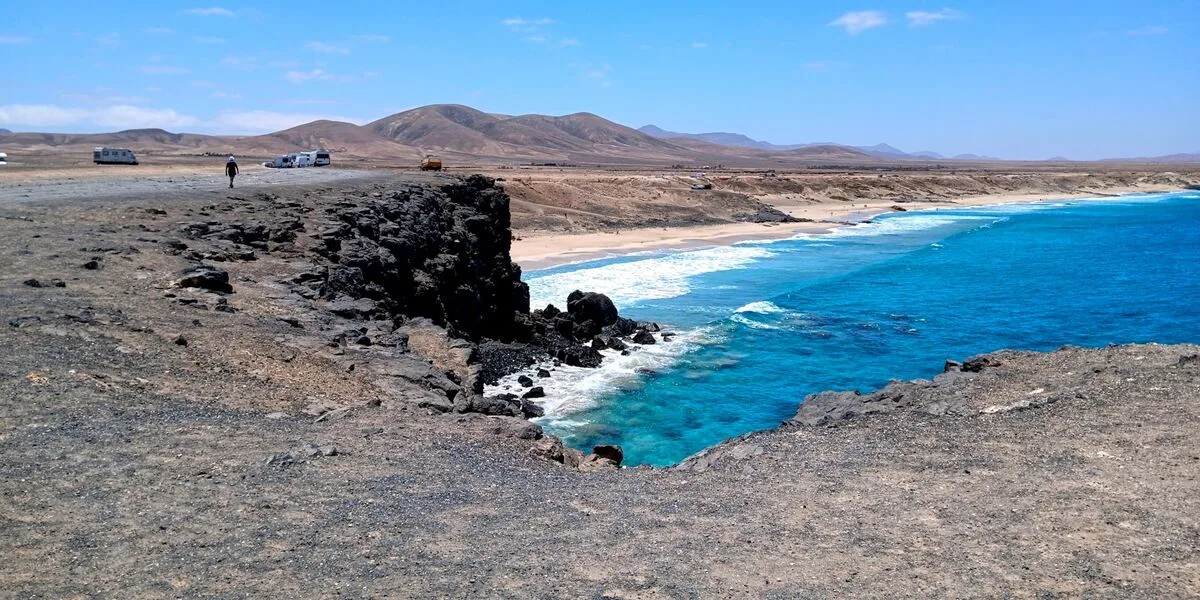
For most British travellers, “winter sun” has meant the Canaries for fifty years, and the reasons have not changed: four hours from almost any UK airport, no time difference worth naming and a southern coastline that stays mild and mostly dry while Britain goes dark. Cape Verde is the challenger some eight hundred miles further south, promising that January will actually feel like a beach holiday rather than a pleasant spring day. The promise is real. So is what you give up to collect it.
This is a comparison of archipelagos, not resorts, so it uses the stations the meteorologists use: Tenerife South for the Canaries’ winter coast, and Sal for Cape Verde. The pattern holds broadly for their neighbours: Lanzarote and Gran Canaria run a degree or so cooler than south Tenerife, and Boa Vista has no long-term station of its own, but sits sixty kilometres from Sal in the same wind and the same sea.
The Canaries remain the right default for most winter-sun trips: half the travelling for practical purposes, flights from around eighteen UK airports, every kind of holiday at every price, and a south-coast winter that is reliably mild. Choose Cape Verde when the one non-negotiable is warmth in the deepest weeks of the year (January runs roughly 3°C warmer by day, the sea 3–4°C warmer) and when an all-inclusive resort week is genuinely the holiday you want. By calendar: take the Canaries from mid-November to mid-December, when they are near their warm end and the Christmas premium has not landed; take Cape Verde in January and February, when the gap between the two is at its widest.
Warmer, yes. Sunnier, no.
January is the month people are really asking about, so start there. The figures below are official climate normals: AEMET’s 1981–2010 series for Tenerife South airport, and the WMO’s 1961–1990 series for Sal supplied by Cape Verde’s national met institute. More recent averages for Sal run about a degree warmer again, which strengthens rather than weakens the comparison.
| January normal | Tenerife South | Sal, Cape Verde | What it means |
|---|---|---|---|
| Mean daily maximum | 21.7°C | 24.0°C | Cape Verde’s afternoons are dependably beach-warm |
| Mean night minimum | 15.2°C | 18.8°C | Canary evenings want a jumper; Sal’s mostly do not |
| Rainfall | 17mm over ~2 rain days | 5mm over ~1 rain day | Neither is wet; Sal is close to rain-proof |
| Sunshine | ~6.2 hours a day | ~5.9 hours a day | The warmer islands are not the sunnier ones |
| Sea temperature | ~19–20°C | ~23°C | The single biggest difference you will feel |
The sunshine row is the correction this comparison needs. Cape Verde’s winter sits in the path of the harmattan, the dry northeast wind that carries Saharan dust across the islands from late November to mid-March; NASA’s Earth Observatory describes dusty winter skies there as routine. The result is warmth under a sky that is often milky rather than blue. The Canaries have their own version, the calima, a Saharan dust intrusion that AEMET tracks with daily forecast maps, but there it is an event rather than a season.
The other correction is about the shape of the winter. The Canaries do not hold one temperature from November to February, and the popular impression of them is usually a November memory:
| Mean daily maximum | Nov | Dec | Jan | Feb |
|---|---|---|---|---|
| Tenerife South | 24.8°C | 22.8°C | 21.7°C | 22.0°C |
| Sal, Cape Verde | 27.3°C | 25.2°C | 24.0°C | 24.1°C |
Read the first column against the third. A mid-November week in south Tenerife is close to what a January week on Sal delivers, at a fraction of the flying and usually a fraction of the price. That is why the timing recommendation matters as much as the destination one: the Canaries’ case is strongest early in the winter, and Cape Verde’s case is strongest in its depths.
One more honest number: both archipelagos are windy. Sal’s trade winds average around thirteen knots across the year with gusts near double that, which is why it is one of Europe’s winter kitesurfing capitals; the western beaches around Santa Maria are the sheltered side. In the Canaries the winter wind is gustier and less constant, and the sharper divide is north against south: Tenerife’s north coast records more than four times the January rain of its south. Winter sun in the Canaries means the south coasts, full stop.
Choose the Canaries for choice, and for November
The Canaries’ real product is not temperature. It is optionality. Five airlines fly from all over the UK all winter, often several times a day, which means you can book late, fly from your nearest airport, change plans without losing the holiday and choose anything from a studio apartment to a five-star spa. No other warm-in-winter destination within five hours of Britain offers that depth.
The Canaries are the stronger fit when
- your dates fall between early November and mid-December, when the islands are near their warm end and prices are pre-Christmas;
- you want the week to contain more than a sunbed: Teide, laurel forests, working towns and proper restaurants are all in range of a beach base;
- you are travelling with children and four hours, no time change and a familiar package market are worth more than three extra degrees;
- you want self-catering, a villa or a room booked three days before departure, the kind of flexibility Cape Verde’s market rarely offers.
The compromise is January and February afternoons around 21–22°C with a sea below 20°C. That is a warm, usable winter day (lunch outside, a walk, a brave swim) but it is not tropical, and a cloudy spell can make it feel like a very good British May. If the picture in your head is heat, read on.
Choose Cape Verde when January must actually be hot
Cape Verde’s offer is certainty. In the depth of winter, Sal’s afternoons hold at 24–25°C, nights stay in the high teens, rain is a statistical rounding error and the Atlantic is warmer than the Canaries manage in high summer. For a January or February beach week where the sea is the point, that is a different holiday, not a marginal upgrade.
Cape Verde is the stronger fit when
- the trip is a beach-and-pool week in January or February and warmth is the reason it exists;
- an all-inclusive resort is what you want: the market on Sal and Boa Vista is built around them, and independent infrastructure is thin;
- you swim seriously: a 23°C sea in midwinter is the headline fact of the whole comparison;
- wind is a feature, not a bug. The same trades that ruffle the sunbeds are why kitesurfers overwinter on Sal.
The compromises are equally clear. The flight is six hours and the schedule is thin: a handful of weekly departures per airport rather than a daily shuttle. Off-resort choice is limited, especially on Boa Vista. The wind is constant enough that beach comfort depends on which coast you picked. And the winter sky is frequently hazed by Saharan dust: you will be warm, and you may not be able to see the horizon crisply. None of this argues against the trip; it argues against booking it while imagining the Maldives.
The flight decides more than you think
London to Tenerife South is scheduled at roughly four and a quarter hours, and easyJet, Jet2, Ryanair, TUI and British Airways between them connect around eighteen UK airports to it year-round, before counting the other Canary airports. London to Sal is around six hours. TUI carries most of the traffic, flying to Sal from seven UK airports and to Boa Vista from four; easyJet joined in 2025 with Sal flights from Gatwick, Manchester and Bristol. There is currently no other nonstop UK option; Cabo Verde Airlines connects through Lisbon.
The practical difference is not the two extra hours. It is frequency. Gatwick to Sal runs a few times a week across both airlines; some regional Cape Verde routes are weekly. A weekly flight shapes the whole trip: seven or fourteen nights whether that suits you or not, no cheap way to shift dates, and a missed or cancelled departure that costs days rather than hours. The Canaries’ density of flights is an insurance policy you only notice when you need it.
The paperwork is not the same
The Canaries are Spain, so Schengen rules apply: a passport issued less than ten years before arrival and valid three months beyond your exit, the 90-in-180-day visitor limit, and the EU Entry/Exit System, which has been taking fingerprints and photos at first entry since its phased start in October 2025. ETIAS, the €20 pre-travel authorisation, is not yet in force and has no confirmed start date. UK government guidance still describes autumn 2026 as expected, reports suggest it may slip further, and a transition period will follow launch in any case. Check GOV.UK close to travel rather than assuming either way.
Cape Verde is visa-free for UK visitors for up to thirty days, but with homework: every traveller must complete the official EASE entry form at ease.gov.cv at least five days before arrival and pay the airport security tax online, roughly €31 at the time of checking. Since 1 July 2026, arriving unregistered means paying double at the border. Your passport needs six months’ validity, and package operators do not reliably do the EASE step for you: unless yours confirms it in writing, assume it is your job. Two smaller notes: Cape Verde is an hour behind the UK in winter, and Sal actually gets slightly more January daylight than Tenerife: about eleven hours against ten and a half.
What to settle before paying
Decide the week before the destination. If you can travel before mid-December, the Canaries at their warm end are the better purchase almost regardless of taste. If the trip must happen in deep January or February and must feel hot, that is Cape Verde’s window. Book it as the resort week it really is, not a Canaries substitute.
- In the Canaries, stay on a south coast for winter sun; the north coasts are several times wetter and cloudier in January.
- On Sal, the sheltered western side around Santa Maria is the comfortable beach in the trade-wind season; east-facing coasts belong to the kitesurfers.
- Book Cape Verde flights and hotel as one package: the thin flight schedule makes independent recombination fragile, and the market prices accordingly.
- Complete the EASE form as soon as dates are fixed; it is required at least five days out, and the fee doubles at the border if you skip it.
- Compare like with like on price: the Canaries’ range runs from budget self-catering to luxury, while Cape Verde is a narrower, mostly all-inclusive market, so check what a comparable board basis actually costs before concluding either is “cheaper”.
- Insure the whole itinerary and check the FCDO page for each destination shortly before travel rather than relying on what was true when you booked.
And if reading all this reveals that what you actually want is escape from British greyness rather than beach heat (daylight, green hills, lunch outdoors), there is a third answer in the same ocean. We have covered it separately: Madeira in February.
Sources and what they support
- AEMET, Tenerife Sur airport climate normals 1981–2010: Canary temperatures, rainfall, rain days and sunshine; with Tenerife Norte normals for the north–south contrast and Lanzarote airport normals.
- WMO World Weather Information Service, Sal (data from Cape Verde’s INMG, normals 1961–1990): Sal temperatures, rainfall and rain days.
- DWD Klimatafel, Sal and DWD Klimatafel, Tenerife Sur: night minima, sunshine hours and the sea-temperature series for both stations.
- NASA Earth Observatory, Cape Verde under dust: the winter harmattan and its haze; AEMET mineral-dust forecasts: the Canary calima.
- Windfinder, Sal airport wind statistics: long-term trade-wind averages (annual figures; monthly detail varies).
- FCDO Spain entry requirements and GOV.UK on the EU Entry/Exit System: Schengen passport rules, EES status; European Commission: the €20 ETIAS fee and its pending start.
- FCDO Cape Verde entry requirements: 30-day visa-free entry, the mandatory EASE pre-registration, the doubled tax for the unregistered from July 2026 and passport validity.
- FlightConnections, Tenerife South and Sal route data (checked July–August 2026), with TUI Group’s Cape Verde expansion announcement and easyJet’s Gatwick–Sal route page: carriers, airports and flight times.
- Time.is, Canary Islands and Sal: time zones; January day length is approximate from standard astronomical data.
- 1 August 2026
- Climate normals (AEMET 1981–2010; WMO/INMG 1961–1990 with newer means noted), sea temperatures, UK flight schedules, EES and ETIAS status and Cape Verde’s EASE rules checked. No live package prices included.