
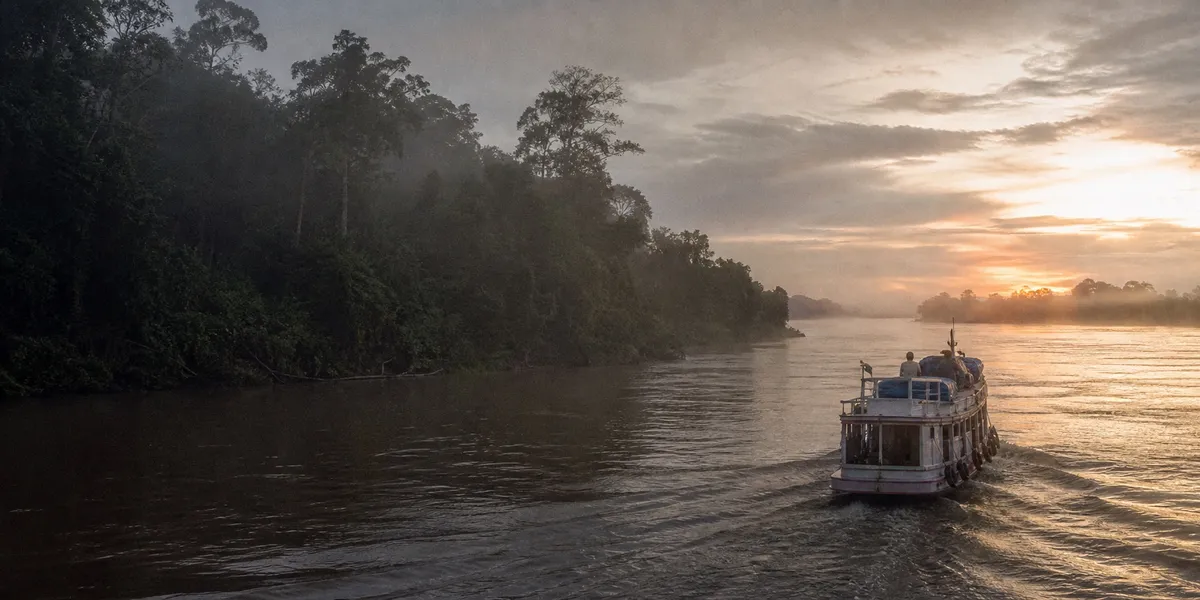
An Amazon lodge stay and a public riverboat journey offer different experiences. Manaus is a Brazilian city with a wide choice of operators; Iquitos is a gateway in Peru. A passenger boat is transport for local journeys and cargo, so it should not be booked as a cheap wildlife cruise.
Think about how you want to spend the days. A lodge with guided excursions suits wildlife watching. A longer passenger-boat journey suits travellers who want time on the river and are comfortable with basic facilities.
For a first Amazon trip, use Manaus as a gateway and spend the money on a carefully vetted river or lodge operator. Choose a long public-boat passage only if ordinary river travel, not wildlife density or comfort, is the actual point.
Manaus: the practical first doorway
Manaus makes the Amazon leg easier to contain. It is a metropolis with an airport, hotels and a remarkable cultural anchor in the Teatro Amazonas. Brazil’s official tourism site describes it as a gateway for river trips, the Meeting of the Waters, freshwater beaches and forest stays. That mix matters: a delayed or weather-affected excursion does not leave you with nothing to do.
The Meeting of the Waters can fit into a shorter visit from Manaus. A lodge stay farther out gives you more time for guided trips on tributaries and in the forest. Ask how long the transfer takes and what excursions are included.
Choose Manaus if
- this is your first Amazon journey and you want a robust gateway;
- you value a city day before and after the river;
- you want several operators and accommodation levels to compare.
Iquitos: commit to the river earlier
Iquitos has no road connection to the rest of Peru’s national road network; most international visitors arrive by air and leave the city by boat for forest journeys. That isolation changes the rhythm. It can make the Amazon feel less like an excursion from a city, but it also makes missed connections and operator quality more consequential.
Pacaya-Samiria National Reserve is the compelling name in many itineraries. Do not compare two trips only by whether both mention it. Compare the actual route, water level, travel time, guide ratio, boat size, included excursions and how many hours are spent inside the area that attracted you.
Choose Iquitos if
- the Peruvian Amazon is the centre of the trip rather than an add-on;
- you want a lodge or expedition itinerary designed around guided wildlife observation;
- you can leave recovery time around domestic flights and boat transfers.
A passenger riverboat: when the route is the experience
A multi-day Brazilian passenger boat can be one of the world’s great transport experiences. It can also be hot, noisy, crowded, basic and difficult to verify from abroad. Timetables, vessel standards and ticket arrangements may change locally, and no amount of research from abroad will pin them down. Accept that before booking, because the unpredictability is part of what you are buying.
This choice makes sense when you want to watch settlements and cargo move along the river, read, sleep and accept long stretches without a programmed sighting. It is not a budget wildlife cruise. The crew’s job is transport. You are responsible for understanding the sleeping arrangement, food, water, security, sanitation, boarding point and arrival uncertainty.
| Shape of trip | What you are buying | What can disappoint |
|---|---|---|
| Manaus + lodge | Easy gateway, guide, short immersion | Too much transfer; “jungle” too close to city |
| Iquitos expedition | Wildlife-led programme and remoter access | High price; itinerary differs by water level |
| Passenger boat | Time, scale and local transport life | Comfort, schedule and little guided wildlife |
The river has its own calendar
The Amazon rises and falls by up to fifteen metres a year on a cycle regular enough that hydrologists call it the flood pulse, and the peak arrives at different months depending on where you stand. Near Iquitos the water peaks around May. Near Manaus the crest arrives in June and July, months after the heaviest rain, because the sheer volume of water backs up on itself as it drains. Levels then fall fast through August and September to their lowest around October, the month that has produced Manaus’s record lows in recent drought years.
| Months | The river | What it means for a trip |
|---|---|---|
| April–July | High water: peak ~May at Iquitos, June–July at Manaus | Canoes glide into flooded forest; more of the reserve reachable by water |
| August–September | Falling fast | Beaches and walking trails emerge; some transfers lengthen as channels shrink |
| Around October | Lowest, especially at Manaus | Best walking, but drought years can slow or suspend river transport |
| November–March | Rising again | A mixed, in-between character on most routes |
Ask the operator what water levels are likely to mean for walks, canoe trips and transfers during your dates. Two trips with the same stops can work differently at different times of year.
The safety map changes the romantic map
Current UK travel advice is not a footnote here. At the time of checking, the FCDO advised against all but essential travel to specific river areas in the west of Amazonas State, including stretches west of Codajás and east of Belém do Solimões, as well as other named rivers and areas. That does not describe every route from Manaus, but it rules out treating “the Amazon” as one undifferentiated safe corridor.
Peru needs the same discipline. The FCDO advises against all but essential travel to areas within 20km south of the Putumayo River and the Peru–Colombia border in the Loreto region (the advice covers the Peruvian riverbank rather than the river itself) and warns that armed criminals operate along the Amazon and have targeted solo travellers. Its plain recommendation matches this page’s: use a reputable commercial operator, and stay on the boat where a route passes through areas under advisories.
Health advice also needs a real appointment rather than a paragraph copied from a blog. UK malaria guidance describes a low risk in the Brazilian Amazon Basin, including Manaus, and in parts of the Peruvian Amazon. Bite avoidance, vaccines, individual medical history and the exact itinerary all matter. Speak to an appropriate travel-health professional with time to act on the advice.
A better booking order
- Draw the exact route. City names are not enough. Identify river sections, reserve, lodge and transfer points.
- Read current government advice against that route. Do this before paying a deposit.
- Check travel health. The advice can affect timing, medical planning and insurance.
- Interrogate the operator. Ask who owns and operates the boat, guide qualifications, maximum group size, safety equipment, communications, food and cancellation terms.
- Protect the international journey. Leave slack before the flight home. A river does not care about your separate ticket.
- Only then compare the bed or cabin. Comfort is important, but it is not the first filter.
Sources
- FCDO Brazil travel advice and FCDO Peru travel advice: current regional warnings on both sides of the border and the effect on insurance.
- Amazon Waters, floods of the Amazon River: flood-pulse timing near Iquitos and Manaus; NASA Earth Observatory: October low-water records at Manaus.
- UK malaria country recommendations, 2026: risk descriptions for Brazil and Peru.
- Visit Brasil: Manaus: official overview of the city, river experiences and the Meeting of the Waters.
- Peru’s official tourism portal: starting point for current Peruvian destination and operator information.
- 14 October 2026
- Copy edited for clarity. Existing source-check dates retained.
- 1 August 2026
- Added the river’s water-level calendar (peak flood around May at Iquitos, June–July at Manaus; October lows) and the current FCDO Peru guidance for Loreto and the Amazon corridor.
- 28 July 2026
- UK regional warnings and malaria guidance rechecked. No operator, timetable or price is recommended until a named route is verified.