
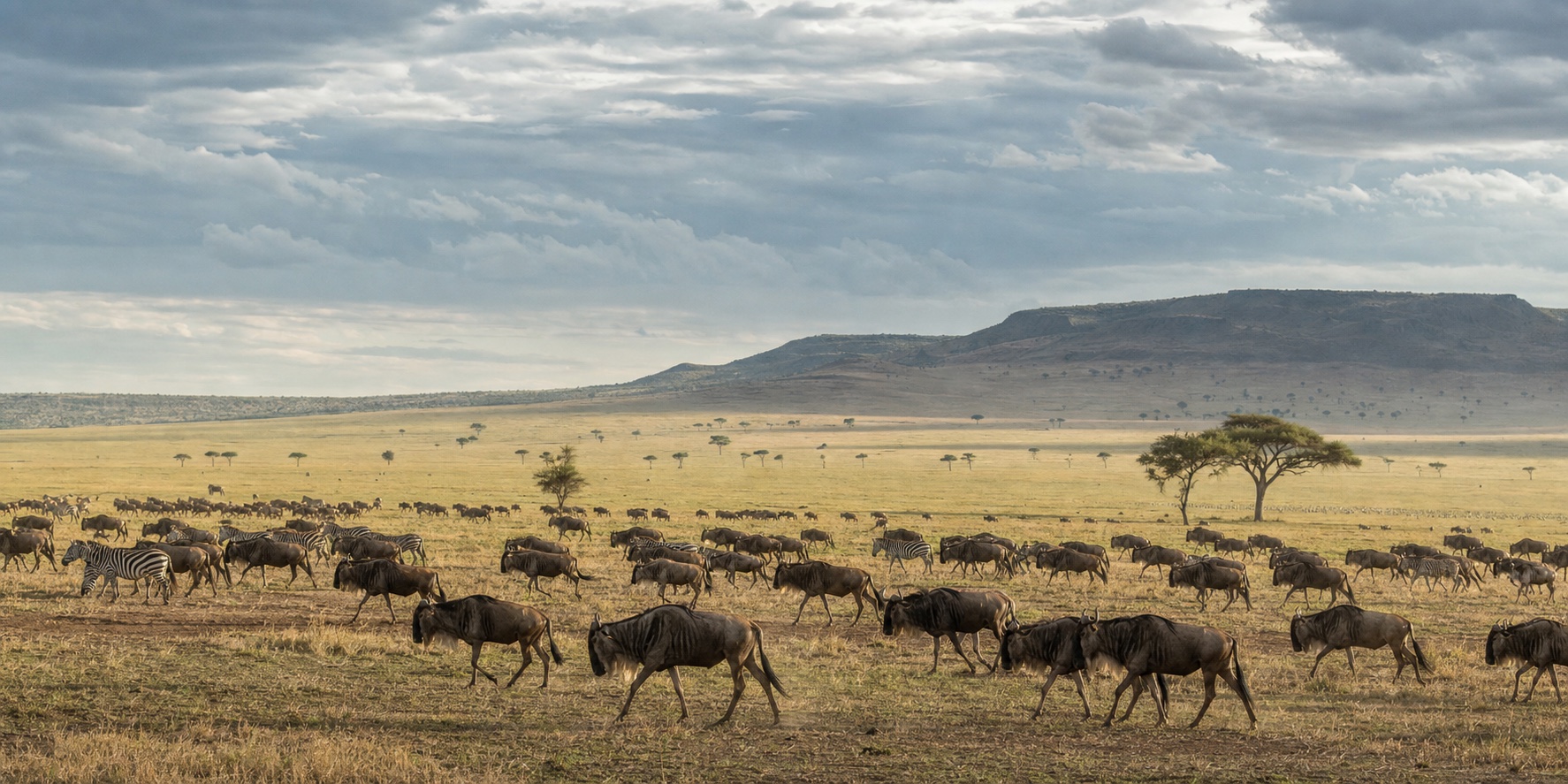
“The Great Migration” sounds like one event with a start time. It is closer to a moving year: wildebeest, zebra and other grazing animals follow water and fresh grass around the Serengeti–Mara ecosystem. The famous river crossings are one tense chapter, not the whole story.
That matters because two perfectly credible safari companies can recommend different countries for the same month. One may place you in Kenya’s Maasai Mara, where a shorter trip can deliver concentrated game viewing. Another may use Tanzania’s northern Serengeti, keeping you within a much larger national park and connecting the migration to a longer northern-circuit safari. Neither answer is automatically wrong. The useful question is which itinerary wastes less of your particular week.
For a first migration safari lasting roughly a week door to door, Kenya is usually the cleaner decision: fewer safari regions, less temptation to spend the trip changing camps and a sensible case for several nights in one Mara area. For a longer trip, or travel outside the July–October rush, Tanzania offers the stronger migration calendar and a more varied circuit. In January to March, the southern Serengeti is the clear migration-led choice.
The useful migration calendar
Rain moves the grass and the grass moves the herds, so no table can pin thousands of animals to a postcode. Use this as a regional planning frame, then ask where an operator’s camps and guides were actually working in the same fortnight in recent years.
| Typical period | Where to start looking | What the trip is really about |
|---|---|---|
| January–March | Southern Serengeti and the Ndutu area | Calving on the short-grass plains; young animals and predator activity |
| April–May | Central and western Serengeti | Herds beginning to move; greener landscapes, rain and more difficult roads |
| June | Western and northern Serengeti | Long columns of animals moving north; river activity is possible, never scheduled |
| July–October | Northern Serengeti or Maasai Mara | Mara River season, dry-country wildlife and the largest visitor pressure |
| November–December | Central and eastern Serengeti, moving south | Short rains and a less predictable return towards the southern plains |
Tanzania National Parks describes January to March as the southern Serengeti calving season. Its river-crossing guidance also makes the scale clear: this is an ecosystem-wide movement, not a daily performance at one bend in the Mara River. Kenya’s official tourism site describes July to October as the iconic Mara period, but also calls the migration a year-round event. Hold both ideas at once.
Choose Kenya when concentration helps
The Maasai Mara makes sense when you want to spend fewer safari nights moving between regions. It is possible to fly from Nairobi’s domestic airport to a Mara airstrip, settle into one area and use the next several days properly. Driving is possible, but the transfer is not a throwaway hour; compare the time, road comfort and baggage constraints of both routes before choosing.
A well-located Mara camp can put general wildlife, big cats and possible migration activity into the same game drives. That makes Kenya attractive for a first safari, for a traveller adding a few days to another East African trip, or for anyone who would rather learn one landscape than collect three lodge check-ins.
Kenya is the stronger fit if
- you have four or five genuine safari nights rather than ten;
- you are travelling between July and October and accept that a crossing may not happen;
- you would choose consistently good wildlife viewing over a longer checklist of parks;
- you are prepared for high-season vehicle pressure and will question exactly where the camp sits.
The compromise is compression. The same concentration that makes the Mara efficient can produce clusters of vehicles around cats and river points. “Near the migration” is not enough information. Ask how long the drive is from the camp to the relevant sector, whether game drives can enter the national reserve and conservancies, and what rules govern off-road driving where you will actually stay.
Choose Tanzania when the journey has room
Serengeti National Park covers 14,763 square kilometres according to Tanzania National Parks. That scale gives a Tanzania itinerary more ways to follow the migration through the year—and more ways to spend expensive hours getting from one camp to another.
Between July and October, the northern Serengeti can place you near the Mara River without crossing into Kenya. Earlier in the year, the southern plains around Ndutu are the migration story. Central Serengeti remains valuable for resident wildlife and as a staging point, but a camp chosen for a convenient map position may still be a long drive from the herd concentration that week.
Tanzania is the stronger fit if
- you have at least seven safari nights and can give the north real time;
- you want to combine Serengeti with Ngorongoro, Tarangire or another distinct habitat;
- you are travelling in the January–March calving period;
- you are willing to fly one leg or accept long road transfers rather than pretending the parks are adjacent.
The compromise is itinerary creep. A map full of famous names can leave each day dominated by packing, gates, dust and arrival times. Three nights in the right Serengeti region will usually tell you more than one night each in three regions selected to decorate an itinerary.
Do not buy a crossing promise
A river crossing can start after hours of stillness, happen out of sight, or not happen during your stay. Herds approach and retreat. Weather and grazing alter their movement. Even if animals cross, your vehicle may be one of many trying to observe without blocking the approach.
Tanzania National Parks publishes specific Mara River crossing guidance because vehicle behaviour can disrupt the animals and the experience. That is a useful test for an operator. Ask how its guides handle a crowded crossing point and whether they will leave a bad situation rather than add another vehicle to it.
Build from nights in habitat, not country count
- Fix the month. School holidays, rain tolerance and total trip length come before a country preference.
- Choose the wildlife chapter. Calving, moving columns, river season and green-season landscapes are different trips.
- Count usable safari nights. Arrival in Nairobi, Arusha or Kilimanjaro is not automatically a game-drive day.
- Map every transfer. Mark whether it is by road or light aircraft, the realistic duration and what happens after a delay.
- Stay longer in fewer places. A second dawn in the same area is not repetition; it is how the guide uses yesterday’s information.
- Add a non-migration reason. Resident wildlife, landscape and guiding should still justify the route if the herd moves early.
Questions that expose a weak itinerary
Do not begin with the thread count in the tent. Begin with the ground operation. The UK’s current Tanzania advice says to use reputable operators and points travellers towards the Tanzanian Association of Tour Operators. Kenya’s Tourism Regulatory Authority provides a licensed-entities route. Membership or licensing is a first check, not a complete verdict.
- Who is the licensed ground operator, not merely the overseas seller?
- Which exact reserve, conservancy or Serengeti sector contains each camp?
- How many travellers share the vehicle, and does everyone have a window position?
- Are game drives private, shared or limited by camp schedules?
- How does the itinerary change if the herd is several hours away?
- What is the plan for vehicle failure, illness or a missed bush flight?
- Which payments are refundable, and under what written terms?
Health and safety are route decisions
Read the complete, current government advice for both countries, not only the paragraph about national parks. The FCDO currently advises against travel to specified parts of Kenya and against all but essential travel to specified parts of Tanzania. Those warnings do not describe every mainstream safari circuit, but an itinerary must be checked against the actual map and any onward beach or border travel.
Arrange a travel-health consultation with enough lead time. Current TravelHealthPro guidance identifies malaria risk in Kenya and recommends yellow-fever vaccination for most eligible travellers visiting the Maasai Mara, while stressing that suitability depends on the individual. Tanzania has its own country guidance and entry rules. This page cannot decide vaccines or medication for you.
Remote parks make ordinary problems more consequential. Insurance needs to cover the declared itinerary, light-aircraft transfers if used, medical treatment and evacuation. Ask the operator who coordinates an evacuation and how communication works from each camp.
Sources and what they support
- Tanzania National Parks, Tourism Splash, Jan–Mar 2026 — southern Serengeti calving period and Ndutu context.
- Serengeti National Park, Mara River crossing guidance — migration scale, calving context and responsible vehicle behaviour.
- Magical Kenya, Great Migration — the year-round movement and July–October Mara period.
- Tanzania National Parks map — official Serengeti area.
- FCDO Kenya travel advice and FCDO Tanzania travel advice — current warnings, insurance and park-safety guidance.
- TravelHealthPro Kenya — current malaria and yellow-fever guidance.
- Kenya Tourism Regulatory Authority licensing portal — route to licensed tourism entities.
- 28 July 2026
- Migration timing, operator checks, current UK travel advice and Kenya travel-health guidance rechecked. No live safari prices included.