
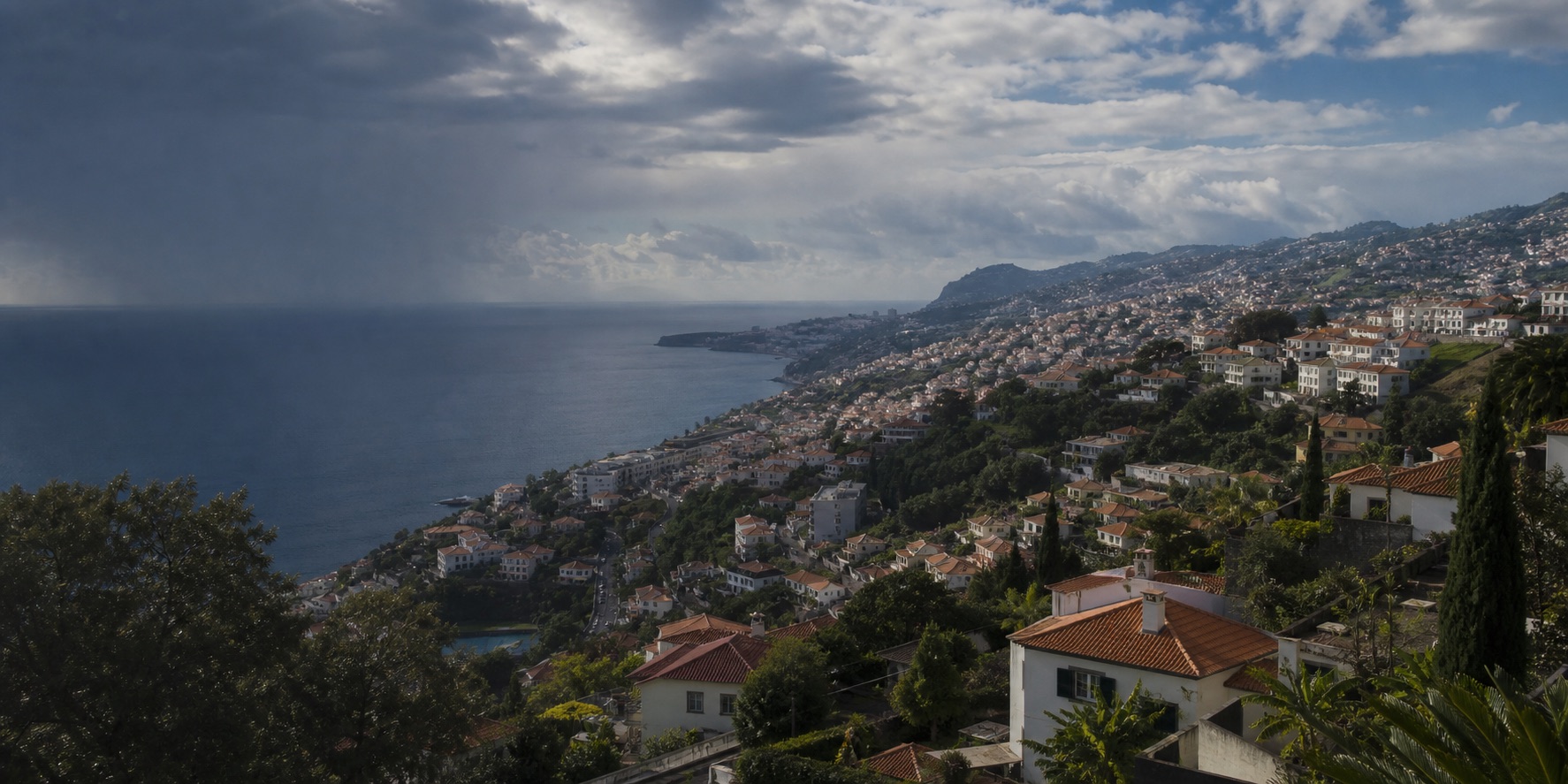
Madeira is often sold as winter sun. That phrase does too much work. Funchal in February is usually mild rather than hot, and the mountains can turn one island into several different weather forecasts before lunch.
This is precisely why the trip can be good. The island is not trying to imitate August. You come for a green Atlantic city, steep streets, gardens and days that can be rearranged when cloud settles on the high ground. The reward is a proper change of scene without a long-haul flight. The cost is giving up any promise of pool weather.
Book four nights in Funchal if you are happy to follow the weather around the island. Do not book it as a beach holiday with a walking day attached.
What February actually feels like
The official 1991–2020 climate normal for Funchal puts February’s mean temperature at 16.8°C and its average daily maximum at 19.9°C. That is light-jacket weather in the evening, often T-shirt weather when the sun is out, and not a dependable substitute for the Canaries if heat is the main requirement.
The more important fact is not the average. It is the variation. Madeira’s tourist board is unusually direct about the island’s microclimates: the south coast tends to be warmer and drier, while the north and mountains are more exposed to wind and rain. A clear morning on the seafront says little about Pico do Areeiro. A grey view from the hotel says little about Ponta do Sol.
Build the trip around that uncertainty and it becomes a feature rather than a grievance. Keep one mountain day, one coastal day and one city day movable until the short-range forecast is useful. Check official trail status before every walk; routes can close for wind, rain, fire risk or maintenance.
Who will like it
- Couples or friends who want a compact city base with ambitious day trips.
- Walkers prepared to swap routes when cloud or closures intervene.
- Anyone who values a brighter, greener change of scene over guaranteed heat.
Who should go elsewhere
- Families booking mainly for a warm outdoor pool.
- Travellers who need one fixed mountain itinerary to work on one fixed day.
- Anyone who will resent carrying both sun cream and a waterproof.
The four-night version that works
Day one: let Funchal earn the short trip
Stay in or within an easy bus ride of central Funchal. Keep arrival day simple: the old streets around Santa Maria Maior, the seafront and a meal that does not require another transfer. The city is not merely a dormitory for the mountains; treating it as one wastes the strongest protection against poor weather.
Day two: spend the clearest forecast on height
If the high-level forecast and trail notices cooperate, use the best day for a levada or mountain route. Choose the walk only after checking its current status and your transport back. A guided small-group day costs more than a hire car split between two, but it removes parking, route and return-transport friction. That can be worth paying for on a four-night visit.
Day three: take the road around the weather
Use a car or an island tour for the north coast, natural pools or western viewpoints. Do not try to “complete” Madeira in a day. Two or three substantial stops, with enough slack to turn towards clearer sky, are more useful than a twelve-stop circuit built for the brochure.
Day four: keep a city-and-coast buffer
This is the day that prevents the trip becoming hostage to the forecast. If the earlier mountain day failed, try again. If it worked, take the cable car, gardens, Câmara de Lobos or a boat trip whose operator is comfortable cancelling when conditions are wrong. Depart the next morning without having spent the final afternoon racing across the island.
A budget that leaves room for the weather
The table below is a planning model, not a live quote. It shows what must fit for the trip to remain good value. Before relying on it, run the same dates through live flight and accommodation searches and replace the allowances with a dated total.
| Four nights, per person sharing | Planning allowance |
|---|---|
| Return flight, cabin bag included | £160–£260 |
| Central room, half of £90–£150 nightly | £180–£300 |
| Airport and local transport | £35–£70 |
| One guided walk or island day | £45–£80 |
| Food beyond breakfast | £100–£140 |
| Working total | £520–£850 |
The upper end is not automatically bad value. A central hotel with a genuinely usable indoor pool, breakfast and flexible cancellation can be more valuable in February than a cheaper room requiring taxis and a perfect forecast. The point of the model is to stop a £99 flight making an £850 trip look cheap.
What to book—and in what order
- Find a flight pattern worth four nights. A late arrival plus early departure can turn four nights into two usable days.
- Hold a central, cancellable room. Funchal is the all-weather part of the plan.
- Decide whether a car earns its days. Do not pay for it to sit in city parking. One or two targeted hire days may be enough.
- Leave weather-sensitive activities flexible. A reputable operator should have a clear cancellation or rescheduling policy.
- Check trails and travel advice again before departure. Old screenshots are not a safety plan.
Sources and what they support
- IPMA Funchal climate normal, 1991–2020 — monthly mean and average maximum temperatures.
- Madeira Tourism: weather and microclimates — winter conditions, coastal variation and the need to check trail status.
- Madeira Tourism: Funchal — city geography and official visitor information.
- 28 July 2026
- Climate data and official visitor guidance rechecked. Price table remains a planning model pending a dated live search.